
Opening and utilizing an offshore business entity has been done by the rich for decades, and for good reason. Opening an offshore business can reduce (or eliminate) burdensome tax structures, can provide privacy protection, reduce reporting requirements and can reduce audit risk.
For those that do business internationally, or on the internet, using an offshore business entity is a smart move.
HONG KONG

Hong Kong is a great choice for opening an offshore business for one very big reason: Any business done outside of Hong Kong is taxed at 0%. Business done inside Hong Kong is taxed at a flat 16.5%. Businesses that incorporate in Hong Kong but operate internationally can eliminate much (or sometimes all) of their tax burden.
Don't let the above picture fool you, even though Hong Kong mostly is a 3rd world slum it is also a world business center and a great place to incorporate. Here are some of the main benefits of opening a Hong Kong company:
- Setting up a Hong Kong company is inexpensive
- Hong Kong is the world's freest economy and has held that record consecutively for 17 years in a row
- Opening a business in Hong Kong is easy.
- Hong Kong is one of the least corrupt countries in the world, it ranks ahead of the USA, Germany, Japan and the United Kingdom.
- Hong Kong has a world class business infrastructure
- In Hong Kong you can easily recruit skilled staff
- English is spoken as one of the two main languages of Hong Kong (Cantonese is the other)
- Hong Kong is strategically located for business in Asia and is the best gateway for doing business in mainland China
- Hong Kong is owned by the People's Republic of China but was developed under and is still ruled by British law. Hong Kong’s legal system is separate from Mainland China’s, and English common law prevails.
- Foreigners can own 100% of a Hong Kong company and are free to be the sole directors and shareholders of a Hong Kong company. There are no local resident requirements and there are no restrictions on nationality.
- A Hong Kong company offers global recognition and is very stable. Hong Kong is one of the world’s major trading, finance and service centers
- To open a Hong Kong company, you don’t need a physical address in Hong Kong and your physical presence is Hong Kong is not required (you may even be able to open your bank account from abroad)
- A Hong Kong company allows you to open up a multi-currency Hong Kong bank account and gives you access to Hong Kong banking
- Hong Kong adopts a territorial source principle of taxation meaning that all profits generated outside of Hong Kong are tax free and profits generated inside Hong Kong are taxed at 16.5%
Who should consider opening a Hong Kong based company?
- Entrepreneurs and businessmen who do a lot of international business.
- Anyone who makes their living via e-commerce or other internet methods (i.e. internet marketers, domainers, internet entrepreneurs etc.)
- Anyone who works directly with Asia.
- Anyone who spends a significant amount of time abroad.
Note: US citizens who spend 330 days or more per year outside of the US, and make their money outside of the US, qualify for the Foreign Earned Income Exclusion. The foreign earned income exclusion will allow you to pay zero income tax on all income earned outside of the USA, up to $92,900 per year. This exclusion, coupled with a zero income tax Hong Kong company, can save you a significant amount of money.
SETTING UP A HONG KONG COMPANY
Setting up a Hong Kong company is easy. In a nutshell, you will pick the name, provide your passport copy, provide your name and address, pay your fees, and then do a yearly audit.
You have two choices to create your company:
1) Do it yourself
- Not recommended unless you have done the required research and know which forms to file, where to go, and when to file your yearly audits. Doing it yourself is the cheaper upfront option but could cost you much more in the long run if you fail to keep up with the required details and paperwork.
2) Use a company that specializes in opening Hong Kong companies for foreigners.
- Using a company is the easiest choice. It will cost you more upfront but you will get some piece of mind knowing that all the i's are dotted and the t's are crossed.
TYPES OF HONG KONG BUSINESS STRUCTURES
You will need to determine which type of business entity you want to use. There are four basic business structures available in Hong Kong:
- Sole Proprietorship
- Partnership or Joint Venture
- Limited Liability Company (also known as a ‘Private Limited Company')
- Branch Office of an Overseas Company
A limited liability company is the recommended entity because it limits your personal liability to the capital subscribed.
You will need to determine the name you would like to use for your company. You must use a name that is not already in use by another Hong Kong Company. You can do a free name search here.
A minimum of one shareholder and one director is required, however the shareholder and the director can be the same person. You will have to have a company secretary and they must be a Hong Kong company or individual. If you use a company to set up your Hong Kong business they will most certainly provide you with secretarial services.
The incorporation of a brand new company takes around eight to ten days but one can buy a “shelf company” and start business almost immediately. This kind of “shelf company” has never traded since incorporation and so has no liabilities.
Shelf companies are ready-made companies which can be used the moment they are purchased. They normally have an authorized capital of HK$10,000 with standard Memorandum and Articles of Association. One can change the name, amend the Articles or increase the authorized capital at any time. Shelf companies are setup in Hong Kong with one subscriber share of HK$1.00 which is the statutory minimum. There is no obligation to subscribe and pay up further capital.
The three typical structures of Hong Kong limited liability companies are:
- Your overseas company holds the shares of the Hong Kong company as a parent company
- You hold the shares of the Hong Kong company as an individual
- A nominee shareholder holds the shares of the Hong Kong company on your behalf as the beneficial owner
SETTING UP A HONG KONG PRIVATE LIMITED LIABILITY COMPANY REQUIREMENTS
The minimum requirements are:
- One Shareholder
- One director
- A company secretary
- A registered office address in Hong Kong
- An auditor(s)
- A Business registration certificate
One Shareholder
Every Hong Kong company must have at least one shareholder, who does not need to be a Hong Kong resident and can be either an individual or a corporation. Shareholders and directors can be individuals or corporations of any nationality or residence.
Nominee shareholder services are available where the beneficial owner wishes to remain anonymous. The shares are issued in the name of nominee companies, which are wholly owned subsidiaries of our company and the name of the owner does not appear on record.
One Director
Every Hong Kong company must have at least one director who does not need to be a Hong Kong resident and can be either an individual or a corporation. The director and the shareholder can be the same person or corporation.
One Company Secretary
The company secretary must be either an individual resident in Hong Kong or another Hong Kong limited company. The company must keep its statutory books such as the register of members and the register of directors, etc. together with minute books at its registered office. It must also file a return with the Companies Registry of its present company structure at the anniversary date of its incorporation. Many Hong Kong companies can act as the nominated secretary and attend to the preparation of the AGM documents and filing of the Annual Return.
One Auditor
Every Hong Kong company is required by law to have its annual accounts subject to a statutory audit. The auditors must be a firm of Hong Kong accountants. An auditor of the company must be appointed within 18 months of incorporation of the company. A Hong Kong company is required to prepare annual accounts which must be audited by a Certified Public Accountant (“CPA”).
Registered Office in Hong Kong
A Hong Kong company must have a registered office in Hong Kong. You may use a virtual office (or holding service) or a company that provides virtual office services. A Registered Office is a statutory requirement under Hong Kong Companies Ordinance and Ordinance for all notices from government are to be sent to the Registered Office.
Register with the Hong Kong Business Registration Office
Every company must register with the Business Registration Office and pay the Business Registration Fee on the anniversary of its date of incorporation. All companies operating in Hong Kong are required to have this business registration certificate to conduct business.
File Profits Tax and Employer's Returns annually
In Hong Kong, there are 3 types of taxes: profit tax, salaries tax and property tax. Your Hong Kong company would only be affected by profits tax (assuming you do not buy property in Hong Kong). The profits tax rate in Hong Kong is 16.5%. If your company does business offshore, you can apply for offshore income with the Hong Kong Inland Revenue Department. When completed your tax rate would be 0%. An offshore income claim is not automatic, it needs to be applied for.
The Inland Revenue Department will select some transactions and request all the documents relating to these transactions to be submitted to ensure that all the company's operations are carried out outside HK, it is therefore recommended to keep all the correspondence for all the transactions e.g. faxes, emails, telephone bills, memos of meetings, purchase orders, sales orders, shipping documents.
File an annual return giving particulars of the Directors, Shareholders and Secretary, together with the Company's capital structure
An annual return of the company must be filed with the Companies Registry every year. A Hong Kong company must also notify the Companies Registry of any special resolution passed (other than that to change the company’s name), the creation of a charge over certain assets and any change which may occur in the information contained in the documents already filed.
Each year, a company must record minutes of its annual general meeting (“AGM”) at which the audited accounts are presented, the directors re-elected and the auditors re-appointed, etc.
HONG KONG PRIVATE LIMITED COMPANY FORMATION FEES
The Fee(s) for starting a Private Limited Hong Kong company will vary depending on which company you decide to use and which extra options you choose. Prices will vary between $1,000 USD to $2,000 USD.
The company pictured below, Asia Business Services, quotes a total price of $8,000 HKD ($1,030 USD) for a Hong Kong Private Company formation and includes one year of secretarial services, one year of office services and help with opening a Hong Kong bank account - in addition to opening the private limited account, taking care of the government regulations and getting your business certificates and company kit (rubber stamps etc).
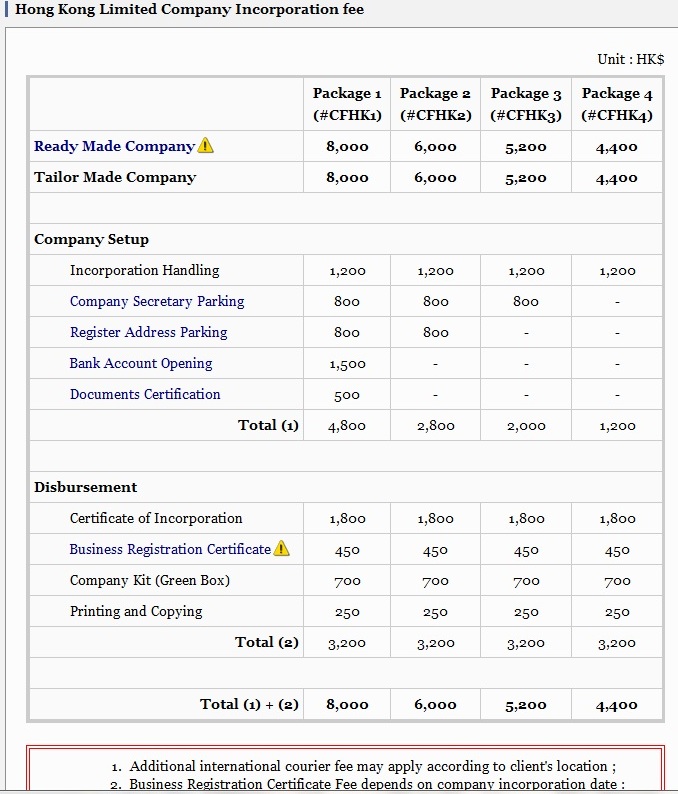
Annual business registration fees paid to the government can vary per year (this year they are less than $100 USD). Annual auditing and accounting fees will vary based on the company you use.
There are many companies available that specialize in helping foreigners open Hong Kong companies. A few hours of google research should help you to find the perfect company for you.
HONG KONG BANKING
One of the great benefits of opening a Hong Kong company is that you will be able to also open a Hong Kong bank account. Unlike most offshore banking centers which try to discourage regular transactions by imposing high fees, Hong Kong banks do not discourage many transactions and have low wire transfer fees to prove it. Unlike tax haven countries, Hong Kong bank accounts are meant to be used for business and not for savings.
For commercial banking for your small offshore company you will likely end up using HSBC, the dominant bank in Hong Kong. There are many smaller banks but they are harder to get into if you aren't a Hong Kong citizen. HSBC is a London headquartered bank, HSBC actually stands for Hong Kong and Shanghai Banking Corporation, and they are currently listed as one of the world's 50 safest banks.
There is a minimum deposit fee to open a bank account in Hong Kong. The minimum deposit fee is typically low but will vary from bank to bank. $1,000 HKD should be enough to get your account started.
With a few minor exceptions, all Hong Kong bank accounts are multi-currency. This means you have just one account number, but when you log in to your internet banking, you’ll see separate balances for each currency. For example you might have some HK dollars, some Singapore dollars, some US dollars, some Euros etc. Of course, you may use only USD if you wish.
Owning a multi-currency bank account is a great way to diversify currency risk and is a common strategy among the wealthy banks of Europe. A multi-currency bank account is also a must if you typically work with more than one currency. Multi-currency accounts are a good, conservative way to hedge against currency risks or make profits with fluctuations. Anyone who wishes to diversify outside of the dollar will need a foreign bank account.
US CITIZENS
One of the greatest advantages of opening a foreign bank account, besides the currency diversification out of the dollar, is privacy. US citizens are obliged to report any and all offshore multi-currency accounts to the IRS, however, private parties like credit rating agencies or lawyers who might want to sue you will not know anything about a private foreign bank account.
Opening a foreign bank account will not affect your tax situation, positively or negatively, as you must declare any and all foreign bank accounts to the IRS.
US citizens cannot avoid paying taxes but you can minimize them through the use of offshore business entities.
GOLD
Hong Kong is one of the best places in the world to buy and hold gold bullion coins. You can hold virtual ounces of gold in a Hong Kong bank account and there are also a number of private safe storage facilities in Hong Kong where you can store gold.
HONG KONG INCORPORATION EXTRA RESOURCES
Hong Kong Official Websites:
- Search for a company name
- Inland Revenue Department
- Hong Kong Companies Registry
- Company Name Guidelines
Articles about Hong Kong Business:
- Starting a Business in Hong Kong (an Introduction)
- Hong Kong Company Registration Guide
- Hong Kong LLC FAQ's
Epic article. This site gets more and more valuable. I would suggest people be careful when buying virtual bullion.
You don’t want a situation where a company has 100 ‘virtual ounces’ out in the market for every one ‘real ounce’ in storage. If the shit hits the fan you will likely be out.
Is it even possible for virtual gold to be sold in this way? Wouldn’t virtual gold be attached to real gold in a real location? Unlike money which can be printed by the Federal Reserve willy nilly?
I could be dead wrong about this as I have not done to much research into gold investments. However I always thought gold seemed to be a quite a safe investment because when you invest in gold I thought you invested in a physical product?
PURE GOLD!!!!! Man, this site is the web’s best kept secret. It’s weird it hasn’t blown up yet. But it will. I have no doubt. Thanks, V. Keep up the amazing content.
This article actually answers allot of questions for me victor. Your article on NZT was great as well. The types of business structures was interesting & I think I will take your advice on hiring a firm that can facilitate foreigners needs.
I have to agree what a great article! I plan on offshoring sometime in the future but really wasnt sure where to go with it. Thanks for the great info.
Sorry for the late comment. Fantastic article Vic, just what a lot of guys are looking for. A step by step guide would still be a great product though.
Russ,
Are you planning on going to Hong Kong sometime soon?
I’m flying via Hong Kong this Winter, a stop-over might be made.
Hello, great read on that one about Offshore company formation hong kong. Nice blog. Keep up posting! Cheers, Thomas.
This is a good start for someone who wants to incorporate in Hong Kong.. The major downside being that nominees are expensive, and this entity is not private without nominees.
Further, yearly audits from a Hong Kong accountant are required.
You might also consider a Belize Incorporation, which has fewer yearly requirements. http://flagtheory.com/new-offering-belize-llcs/
Or a wyoming LLC - which is a great option as well http://flagtheory.com/wyoming-llc-wyoming-switzerland-usa/
love the site but anyone who calls hong kong a third world slum has obviously never been there or suffers from a lack of knowledge
Vic, this is amazing! many thanks for your effort. I find it very useful.
Let’s say I build and ecommerce empire with this Hong Kong method. 5-10 years down the road someone wants to buy my company. Do you think that will affect how much I could make for not having anything physically in the USA? Or will it only help the value of the company?
I think I aswered my own question. I had an epiphany yesturday while thinking about my business and remembered this article. Thank You so much.
Danny
Since I have written this article I have come to the obvious conclusion that you SHOULD NOT start a HK based company unless you are based in HK. HK requires a yearly audit of your company by a HK accountant which you must pay for and comply with. Not worth it. Go offshore with an IBC that doesn’t require auditing and has low/no tax, or stay in the States.
Specifically regarding your question, who cares where it’s located? If they want to buy it, they want to buy it.
I ask because I will be selling products that are made in china. I may even be using a a fulfilment center in china to ship the products to the customers. Looking to minimize costs anyway possible.
Not bad advice, but some companies need to look “legitimate” (ie: a client of mine who does high-level consulting) or need payments from big companies like Amazon that won’t pay IBCs on a rock somewhere. IBCs work well for many like e-commerce sites, but not for all.
You can open a bank account in Singapore or Hong Kong or wherever, you aren’t limited to using banking facilities in whatever little island your company is incorporated in.
Sometimes. Hong Kong banks are tightening up on Seychelles companies, for instance, especially if you’re a US citizen. As Hong Kong wants to join the OECD, they are “cleaning up their act”. You are correct, but I think this will be harder going forward.
They were cleaning up their act when I opened my account years ago, but I had my act together and it was not a problem.
Pure Gold, it would be useful if you wrote about taxes and worker’s salary- how that goes (workers who are employed in offshore company butt work in the country where the business is located), and how to get legally to your money from an offshore LLC company. Respect.
I would like to hear from this too.
Kindly,
I second that as well.
Hi must say thumbs up. Tanks buddy this Will save me a loooooooot.
Great post and really informative. Sadly, while Hong Kong is still a great company “flag”, banks there are less and less open. I would advise you to go there to set up an account as banks have cracked down. You are also correct that you REALLY need a professional to manage things on an ongoing basis; there are some company secretaries there that are worthless and could jeopardize your company. Have someone help you!
Andrew, please STFU. You are nobody to come and give advise, you censor people comments on your blog full of lies and fantasy. You are very dangerous for the community of nomads, you are so spammy when people get in to your newsletter, with pushy marketing and you spam everywhere with your comments only to get your website attached under your name. I am doing my best to show your real face in every forum of nomads and winners, because with your advise you only want to suck our money and turn us in to losers with a very probably legal problem.
Good post at all. Great post and really informative. This Site is getting better with time.
Hi Does anyone has any recommendations for audit? We read about your blog last year and incorporate a HK company to do ecommerce business. We have not reached our tax year yet but we are researching and they said it’s quite costly to get offshore status in HK. Is it true?
Is it very difficult to apply for offshore status and exempt from HK taxes?
Yes, if your HK company is not making large profits, your offshore profit claim service from your company secretary could cost you more than your actual tax amount to be paid… Also this process could be as long as 2-3 years and cost of sending documents and other proofs to IRD, back and forward to HK should also be considered.
And in the end it is not guarantied you will be exempted from paying tax even if it is true offshore trade and all proofs you submitted indicate the same, but maybe not enough for the HK IRD to accept or some other factors will decide this…
If any experts would like to share some light on this matter, I would really appreciate it.
Like on profit tax reductions ?!?
or other means of getting profit tax avoided/reduced other than claiming offshore tax and getting into whole long term tax claiming procedure.
Also if you could recommend some tax claim service providers that are specialized in this area and could disprove my earlier claims especially in relation to their service cost and duration…
Do you have any kind of indication on how much the service fees could be for the offshore tax exemption claim?
Just saw your update Vic, so where did you set up in the end if Hk was not desirable ?
I have a company in Australia which is an online Fashion business but i am planning to move my company to Hong Kong anf close my Australian company.
Any advice would be highly regarded
Hey Vic champ
I will register a business and bank account in Hong Kong this month and sticking with your guide only, because I trust is most.
Is it all still applicable or is some of it outdated?
Thank you for your reply
Jonas the Digital Spartan
I mean *this year
I registered a Limited Company in HK a few years back (still rocking it), and I can tell you, that “0%” tax thing looks very nice on paper, and is widely advertised by business registration companies in HK, but in real life it is not as they vaguely claim (very misleading in my opinion as they know how things really are with IRD but do not disclose it upfront, I guess to get more people to register HK companies motivated by that twisted premise $$$).
The truth is that in order to apply for such an offshore claim (because it is neither automatic, nor straight forward), it is a real pain in the butt as you will get tons of questions from the IRD to demonstrate you claim with proof of every tiny freaking detail you can (and can’t) imagine, about how you run your business, like: how did you find the customer, how was the transaction effected abroad, flights itineraries, passport stamps, where were you and the customer/supplier at each negotiation, their names, address, relationship with the company and their directors ((deeply inhale)) how the selling price of the goods was determined and where, how did you receive the money, how were the goods shipped, how long time did you spend in HK in any given moment, and many others… (YMMV). So you must keep all documentation, of everything to the smallest detail; they might even ask for email records, faxes, records of phone numbers called…
And they give you a deadline to provide all this, so you must have all these documents prepared in advance, or just wait until then to star collecting all this and have a panic attack trying to comply with it before the deadline.
So your agent in HK must get involved and relay all these answers/documents you provide to the IRD, clarify all further questions that might arise from their analysis, while you pay for all the working hours this might take to handle.
And at the end, it is all up to the IRD to determine if they consider (because from what I have seen is very relative) if they will accept this claim or not. Hence probably will still end up paying taxes if they determine so anyway, plus all the fees you had to pay, and time and focus wasted to go through all this BS (excuse my french).
So in short, if you are a start up, a small company, a one man operation, save yourself a lot of headaches, time and money and just consider that 16.5% tax on your profits and focus your time and energy on your business operation and make more money. By the way, your accountant can advise you about some deductions you can apply so the final effective tax rate % on the profits is lower than that ;) .
If you still want to go for the offshore claim, and have the resources (money and people to keep/amass all the paperwork organized), by all means go for it, but you’ve been warned.
Some accountants will tell you that it is not worth to apply for an offshore claim if your turn over is less than 1,000,000 HKD in a year, I don’t know how do they quantify that as each business margin is different, but that is an interesting take on it.
Additional note on this: I heard from people with experience on international taxation that by achieving this elusive 0% tax in HK, you might open yourself to be targeted by other jurisdictions (your customers’ or even the one where you have your residence/nationality) which might consider your company liable to pay taxes there somehow, and by not being able to show tax residence of your company in HK, then you could be challenged on being liable for taxes there. I haven’t seen this first hand yet, but worth of mentioning for your consideration. If anyone knows more about this, I would like to know more about how could this play out.
Other important notes for those interested in HK company formation:
- Know that you are required to do audits of your taxes every year (normally same accounting firm have someone who can do audits in-house or a partner). If you don’t do the audits, it might bite you back later as there could pass 2, 3, 5, 10 years before you get a request form IRD to check your previous years’ audited accounts (which come with a short deadline for submission), so be always up to date with that if you want to avoid a mini heart attack.
They might also ask for these when requesting the company to be closed, which by the way is a lengthy process that might take around 6-8 months, and if renewal date falls within this time period (which is very likely) you must still pay all renewals AR, BR, etc, etc.
- It is very important to comply to the letter with HK regulations as failing to do the proper reporting/auditing and not keeping up with your responsibilities as company’s director is ground for prosecution. Yes, it is that bad…
- Also be aware of the cost of maintaining your HK company. Between RO, CS, AR, BR, Tax calculation and Audit (without taxes themselves added yet) you could be looking at about 2,000-2,500 USD per year depending on the company you choose for the company maintenance.
- I’ve heard that bank account opening in HK is getting more and more difficult, specially for non HK residents, and even worse for American citizens. Research about your specific situation on it before registering the HK company.
- And of course as everything, please get the proper advice from professionals for the registration and the renewals / tax / audits as doing things blindly/cheaply might get you into trouble in the future (been there, done that).
If anybody have had any different experience about the offshore claim, I would like to know.